
How We Make It: A Look Inside the Sevitsil Silicone Extrusion Process
From Raw Compound to Precision Seal: The Science of Silicone Extrusion
Have you ever wondered how a raw piece of silicone rubber transforms into a miles-long, perfectly shaped seal that fits into your precision machinery? It isn’t magic—it’s a rigorous process called silicone rubber extrusion, and it is the backbone of the high-performance parts we deliver at Sevitsil.
While many companies simply ship parts, we believe our clients should understand the process behind their components. When you know how the work gets done, you can see why critical technical factors—like material flow, oven control, and post-curing—directly impact your production reliability.
Here’s a behind-the-scenes look at how we turn raw silicone into industrial-grade profiles:
1. Preparing the Compound
Everything starts with the formulation. Raw silicone polymer is blended with additives, heat stabilizers, and pigments to achieve the required performance.
Like a precise recipe, the mixture must be exact. We verify Shore A hardness, rheological properties, and Mooney viscosity before processing to ensure consistency and performance.
2. The Extrusion Feed
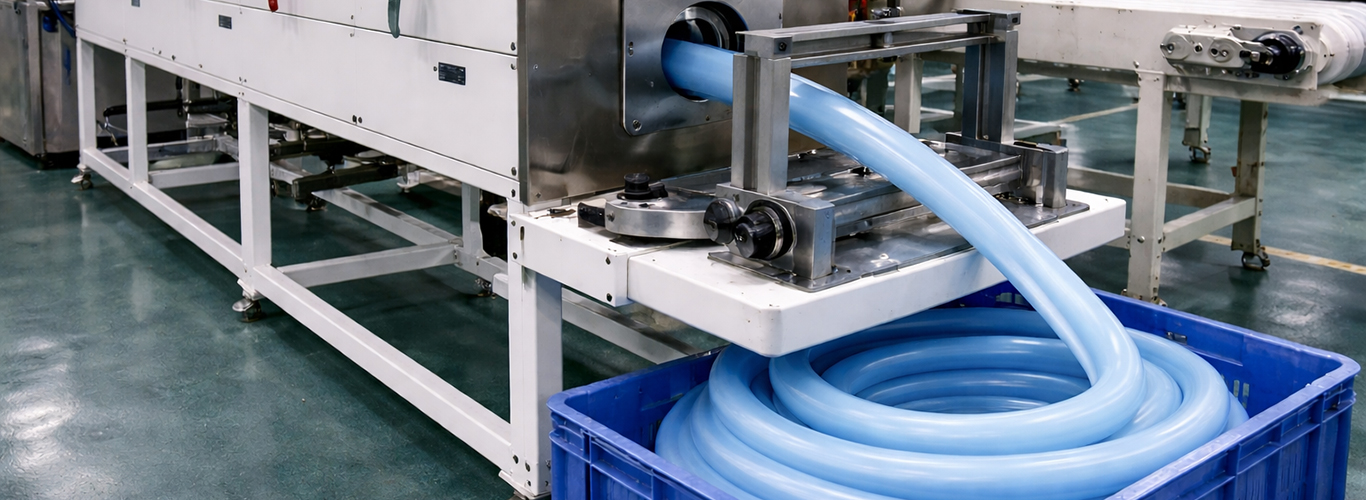
The prepared compound is fed into a high-pressure extruder, where it is forced through a custom-designed die.
The die defines the final shape—whether it’s a simple cord, a complex U-channel, or a custom gasket profile. Precision at this stage determines dimensional accuracy in the final product.
3. Vulcanization (Primary Cure)
As the material exits the die, it is still soft. It passes through a continuous curing tunnel where heat initiates vulcanization.
This process cross-links silicone molecules, transforming the material into a durable, elastic rubber. Temperature and conveyor speed are monitored in real time to ensure uniform curing.
4. Post-Curing (Technical Advantage)
For demanding applications, we perform post-curing in a secondary oven under controlled conditions.
This step removes residual volatiles and stabilizes material properties, resulting in:
- Lower compression set
- Improved thermal stability
- Higher purity for food, medical, and aerospace applications
5. Cooling and Precision Cutting
After curing, the profile passes through a cooling system and is cut to exact specifications.
Dimensional accuracy is critical—even minor deviations can lead to leaks or improper fitting. Continuous quality checks ensure every profile matches your design precisely.
Why the “Sevitsil Way” Matters
- No Voids: Controlled extrusion eliminates air pockets, ensuring structural integrity under pressure.
- Purity: Post-curing ensures low volatile content for sensitive environments.
- Precision: Tight process control guarantees accurate fit and consistent performance.
The “Right Fit” Checklist
Before starting your custom extrusion project, consider:
- Design: Do you have a drawing, sketch, or CAD file?
- Environment: Will it face heat, UV exposure, or chemicals?
- Tolerance: What dimensional accuracy is required?
- Purity Needs: Do you require post-cured or low-volatile silicone?
Let’s Build Your Profile
Silicone extrusion is a precise science, and we specialize in delivering tailored solutions. If you need a custom profile or are facing issues with existing components, we’re here to help.